
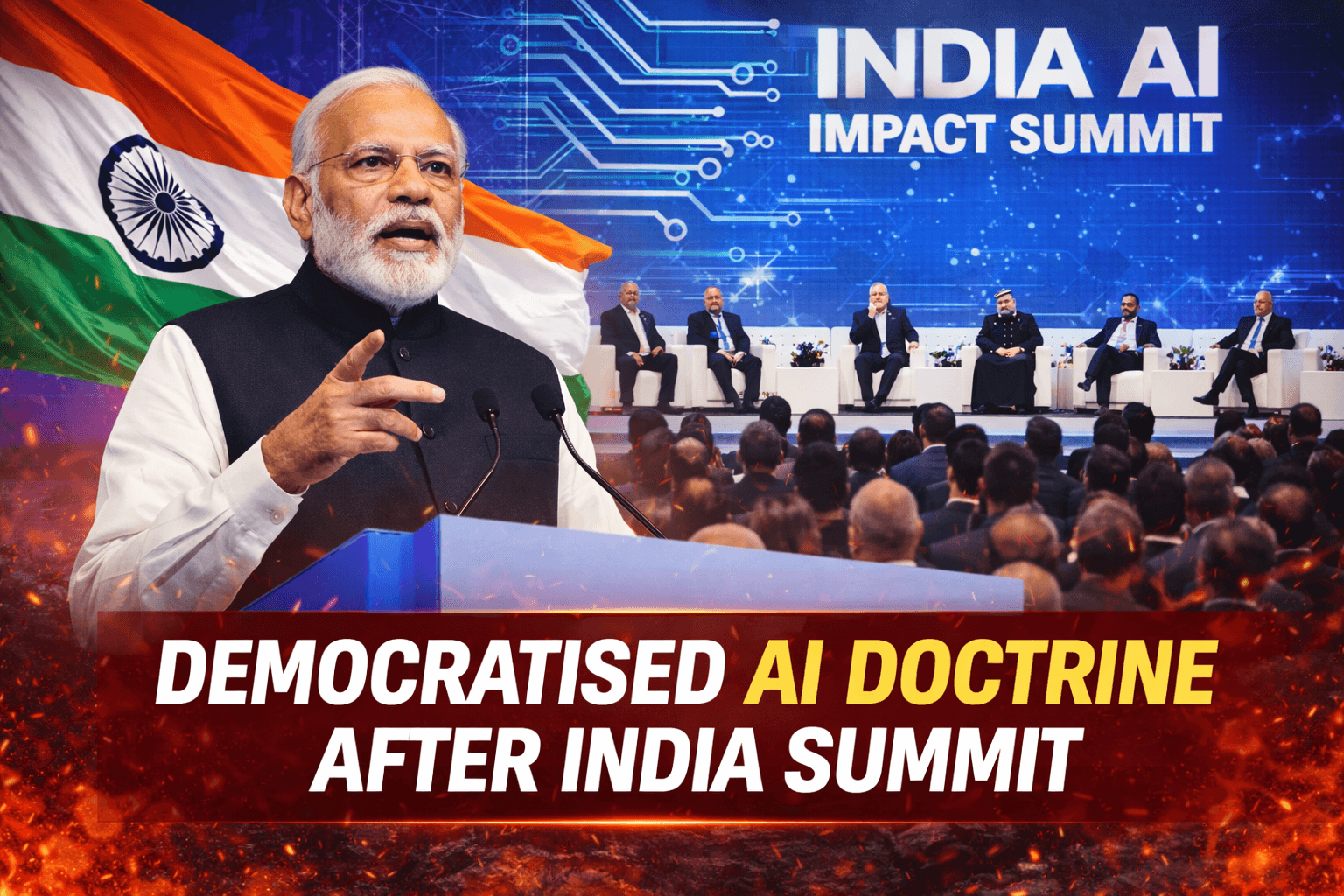
India is expected to push a democratised AI doctrine following the India AI Impact Summit 2026 in New Delhi. Government sources say the framework will focus on access, affordability, and inclusion in artificial intelligence development.
The move is seen as India’s strategic response to the concentration of advanced AI capabilities within a few developed nations and global corporations. However, officials stress that national sovereignty will remain central to any cooperation model.
The final outcome document is still under discussion among participating countries.
Democratised AI Doctrine to Expand Global Access
The proposed democratised AI doctrine aims to expand access to foundational AI tools. For example, it may promote wider availability of computing power, datasets, and research infrastructure.
Sources say India wants to shift the global debate. Instead of technology consolidation, New Delhi is pushing for technology diffusion.
In addition, the framework is expected to encourage open-source AI systems. Officials believe open platforms can help developing nations build their own digital ecosystems.
The doctrine may also support scalable AI use cases. These include:
- Healthcare delivery
- Agriculture productivity
- Climate resilience
- Public service systems
Meanwhile, discussions include the creation of a global AI knowledge-sharing platform. This system would connect research communities across borders.
According to the Ministry of Electronics and Information Technology, India has already prioritized inclusive digital growth.
Readers can explore more national policy updates in our India News section.
Democratised AI Doctrine and Sovereignty Principles
The democratised AI doctrine is likely to remain voluntary and nonbinding. Officials say India will avoid strict regulatory commitments that limit domestic policy flexibility.
However, sovereignty is expected to remain nonnegotiable. Therefore, countries will retain control over their data, security frameworks, and AI governance rules.
Sources underline that the framework will encourage multi-stakeholder participation. Governments, private companies, universities, and civil society groups may all contribute.
On the other hand, India does not want global AI rules to become tools of strategic control. Because advanced AI is currently dominated by a small group, developing countries often face limited access.
As a result, India is positioning itself as a key voice for the Global South.
India as Global South’s AI Advocate
India is expected to highlight equitable access as a core principle. First, it may call for affordable compute infrastructure. Second, it may promote capacity building in AI education. Finally, it could propose collaborative research funding models.
Officials indicate that international cooperation will remain strong. However, national regulatory autonomy will be protected.
The summit saw high-level global participation. Prime Minister Narendra Modi inaugurated the event at Bharat Mandapam in New Delhi.
More than 500 global AI leaders attended. These included over 20 Heads of State and around 60 ministers. In addition, several technology CEOs and researchers participated.
During the Leaders’ Plenary and CEO roundtable, discussions focused on:
- Investment in AI infrastructure
- Cross-border research partnerships
- Deployment of AI in public systems
Meanwhile, observers say the summit signals India’s intention to shape global AI governance norms.
You can read more global technology updates in our World News section.
What Happens After the Summit?
The outcomes expected from the summit are designed to reflect balance. On one hand, India supports innovation and cooperation. On the other hand, it insists on inclusion and sovereign decision-making.
Officials say the final document will likely outline guiding principles rather than strict rules. Therefore, countries can adapt recommendations to their national contexts.
Experts believe the coming months will determine how other nations respond. If widely supported, the doctrine could influence global AI discussions.
In conclusion, India appears ready to push a long-term vision. The democratised AI doctrine may become a central pillar of its digital diplomacy strategy.