
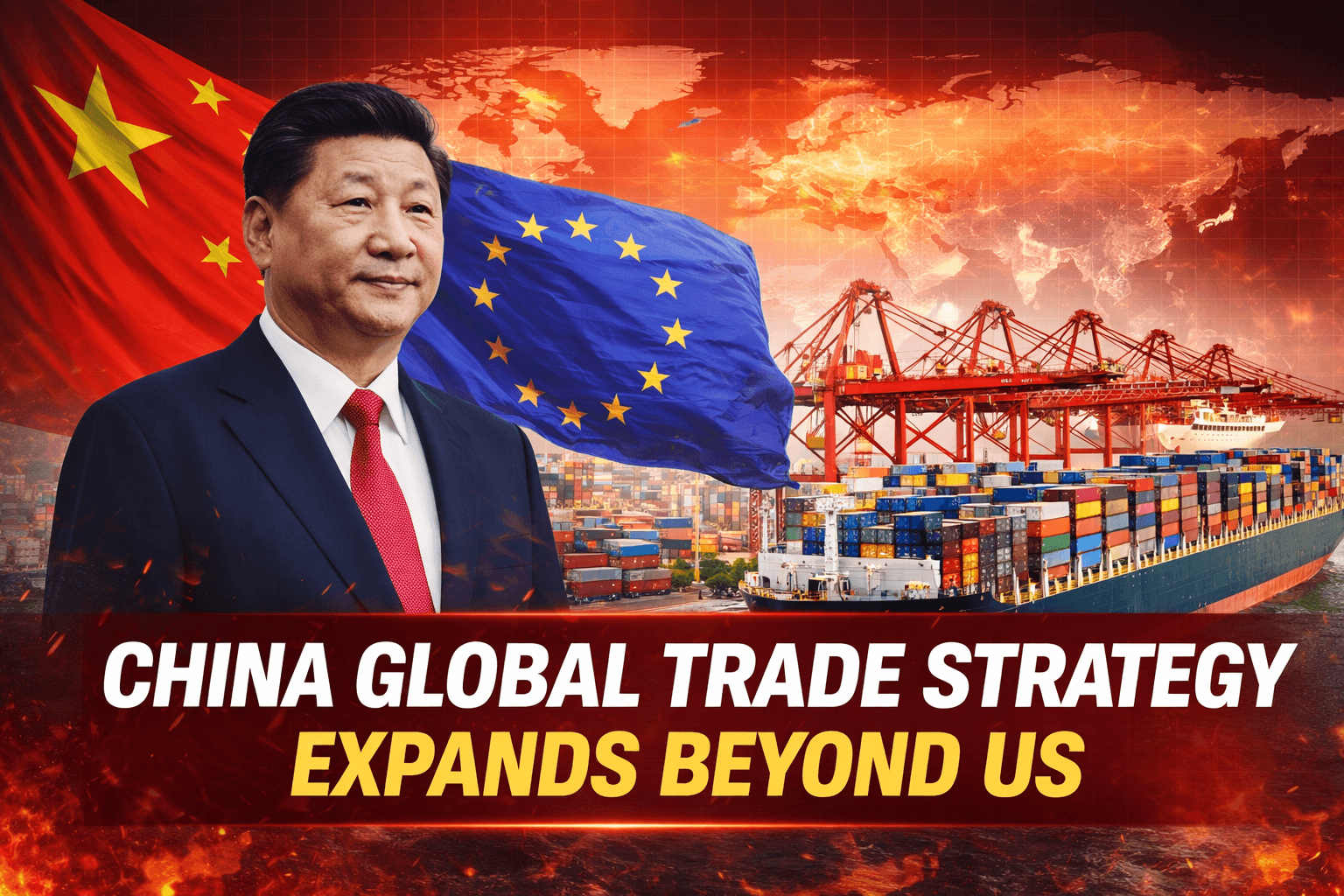
China’s China global trade strategy is entering a new phase as Beijing works to reduce long-term dependence on the United States. While US tariffs under President Donald Trump have created pressure, China sees an opportunity to reshape global trade in its favor.
Beijing is pushing to sign nearly 20 free-trade agreements. Meanwhile, it aims to embed its $19 trillion economy deeper into major global markets. Officials believe this approach can reduce the impact of future US trade restrictions.
China Global Trade Strategy Focuses on Trade Blocs
The China global trade strategy focuses on joining or strengthening large economic blocs. For example, Beijing is working more closely with the European Union, Gulf nations, and Asia-Pacific partners.
Reuters reviewed over 100 policy papers by Chinese trade scholars. These papers show a systematic plan to counter US containment efforts since 2017. In addition, they highlight efforts to reverse-engineer US trade policies.
One important development was a recent agreement with Canada during Prime Minister Mark Carney’s visit to Beijing. The deal reduced tariffs on Chinese electric vehicles. As a result, China hopes to weaken US leverage over its trade partners.
Alicia Garcia Herrero of the Bruegel think tank said China now has a “golden opportunity.” However, she also noted that success depends on how other countries respond.
The US government maintains that its trade policies aim to fix domestic economic problems. According to the World Trade Organization, global trade flows remain sensitive to tariff disputes and political tensions.
Readers can follow more international developments in our <a href=”/world-news”>World News</a> section.
China Global Trade Strategy and ‘Anti-Decoupling’ Push
A key part of the China global trade strategy is preventing economic “decoupling” from Western markets. Chinese scholar Ni Feng wrote in 2024 that anti-decoupling should become a primary focus.
Therefore, China is moving quickly to fast-track stalled negotiations. Since 2017, it has held talks with countries including Honduras, Panama, Peru, South Korea, and Switzerland.
In addition, China has surprised European officials by raising the idea of a free-trade agreement with Brussels. Talks have also resumed with the Gulf Cooperation Council.
Meanwhile, Chinese diplomats are promoting zero tariffs for imports from 53 African countries. This move aims to strengthen economic ties across Africa.
China is also promoting AI-powered customs systems. As a result, trade processes could become faster and more integrated with Chinese platforms.
Challenges Facing China’s Trade Ambitions
However, China’s large trade surplus creates challenges. Many countries worry that Chinese manufacturers could flood their markets with low-cost goods.
Domestic demand inside China remains weak. Therefore, foreign partners may hesitate to open markets further.
Some countries within the Comprehensive and Progressive Agreement for Trans-Pacific Partnership (CPTPP) have concerns. They fear that improved access could increase competition from Chinese products.
On the other hand, Beijing argues that greater integration benefits all sides. Officials say open trade supports global growth and stability.
Experts believe China is willing to accept structural changes at home to secure long-term dominance in global commerce. This may include reforms in subsidies, market access, and technology policies.
For updates on how global trade affects India, visit our India News section.
What Happens Next?
China is expected to continue diplomatic outreach in the coming months. President Trump is also scheduled to visit Beijing in April, which could influence negotiations.
First, Beijing will try to conclude pending agreements. Second, it will seek membership in major trade blocs like the CPTPP. Finally, it will expand cooperation in digital trade and infrastructure.
However, the outcome depends on geopolitical tensions and economic conditions worldwide.
If successful, China could reshape the global trade system. As a result, its economy may become less vulnerable to US tariffs in the future.
The coming year will likely determine whether China’s long-term strategy delivers the dominance it seeks.